Plessy v. Ferguson
A Black civil rights group deliberately challenged segregation. The Supreme Court made it national law.
What was happening?
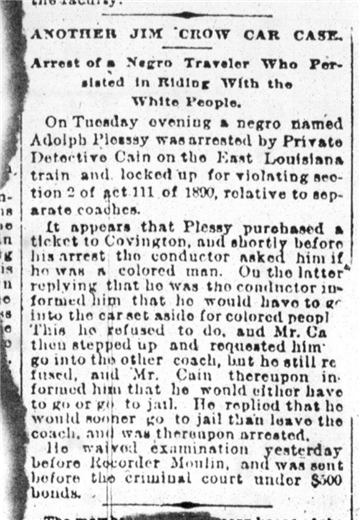
Louisiana's 1890 Separate Car Act required separate railway cars. New Orleans' Comité des Citoyens organized to fight it.
What happened?
Homer Plessy boarded a whites-only car in 1892 to be arrested as a test case. In 1896 the Court ruled 7–1 that "separate but equal" was constitutional.
Why?
The Court said segregation did not imply inferiority. Justice Harlan alone dissented.
How did Black people respond?
The Comité's strategy of planned litigation became the model the NAACP later used to win Brown v. Board.
What changed?
Jim Crow segregation got constitutional approval across the country.
What happened next?
It took 58 years to overturn, in Brown (1954).
How could this still matter today?
Planned test cases remain one of the most powerful tools of civil rights law.
Evidence & sources
Evidence rating: What the ratings mean
- Court case · 1896Plessy v. Ferguson, 163 U.S. 537 · U.S. Supreme Court
Majority opinion and Harlan's dissent.Plessy v. Ferguson, 163 U.S. 537 (1896).
Related stories
- May 17, 1954Brown v. BoardA 20-year legal strategy.
- 1890–1908The Vote, Taken130,334 voters. Eight years later: 1,342.
- Dec 5, 1955–Dec 20, 1956Montgomery Bus Boycott381 days. Who organized it?
Cite this page
APAThe Black American Story. (2026). Plessy v. Ferguson. https://www.theblackamericanstory.com/stories/plessy/MLA
"Plessy v. Ferguson." The Black American Story, 2026, https://www.theblackamericanstory.com/stories/plessy/. Accessed [date].
Chicago"Plessy v. Ferguson." The Black American Story. 2026. https://www.theblackamericanstory.com/stories/plessy/.