Voting Rights Act
Federal law finally enforced the 15th Amendment, 95 years after it was ratified.
What was happening?
Southern states had used literacy tests, poll taxes and intimidation to block Black voting since the 1890s.
What happened?
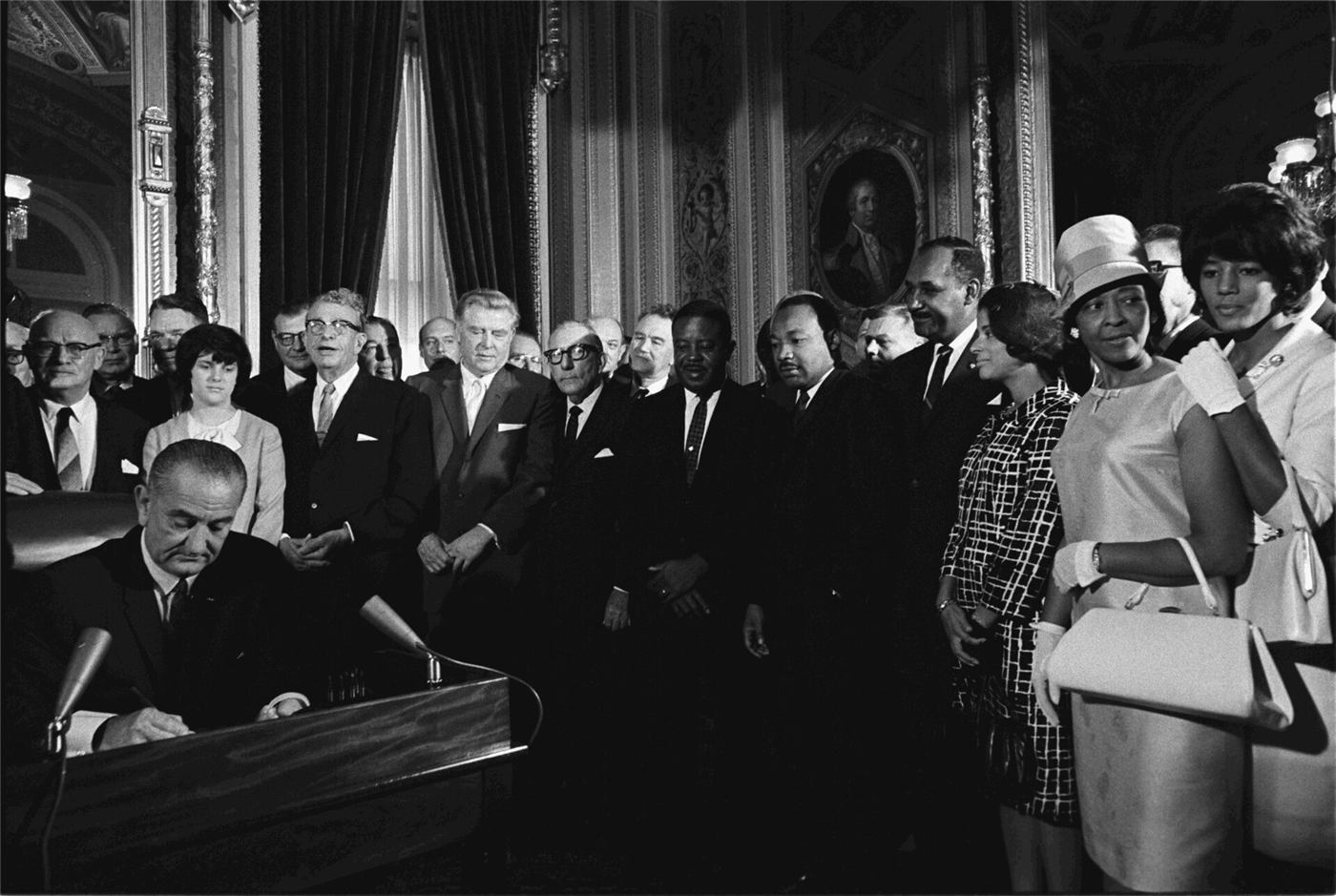
The VRA banned literacy tests, sent federal examiners to register voters, and required covered jurisdictions to get federal approval before changing voting rules.
Why?
Selma, Freedom Summer and decades of organizing.
How did Black people respond?
Black Southerners registered in huge numbers and began electing officials again.
What changed?
Black elected officials nationwide grew from about 1,500 in 1970 to more than 9,000 by 2001.
What happened next?
1975 amendments extended protections to language minorities, including Latino, Asian American and Native American voters.
How could this still matter today?
Shelby County v. Holder (2013) disabled preclearance. Voting-rule changes are now challenged after the fact.
Evidence & sources
Evidence rating: What the ratings mean
- Law · 1965Voting Rights Act of 1965 · National Archives
Full text.Pub. L. No. 89-110, 79 Stat. 437. - Court case · 2013Shelby County v. Holder, 570 U.S. 529 · U.S. Supreme Court
Struck down the §4(b) coverage formula.Shelby County v. Holder, 570 U.S. 529 (2013).
Related stories
- March 7, 1965SelmaIt started with a local voters' league.
- 1890–1908The Vote, Taken130,334 voters. Eight years later: 1,342.
- 1865–1877ReconstructionBlack political power didn't begin in the 1960s.
Cite this page
APAThe Black American Story. (2026). Voting Rights Act. https://www.theblackamericanstory.com/stories/voting-rights-act/MLA
"Voting Rights Act." The Black American Story, 2026, https://www.theblackamericanstory.com/stories/voting-rights-act/. Accessed [date].
Chicago"Voting Rights Act." The Black American Story. 2026. https://www.theblackamericanstory.com/stories/voting-rights-act/.