Chicago, 1919
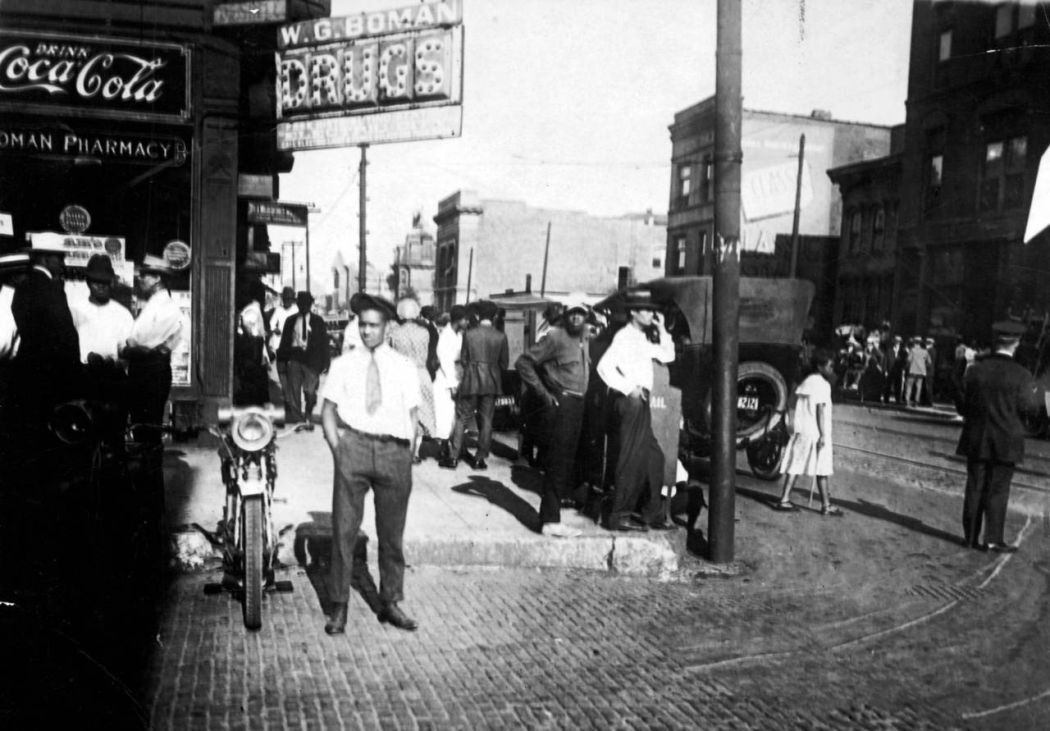
A Black teenager drowned after being stoned at a beach. A week of violence followed.
What was happening?
Chicago's Black population had doubled during the Great Migration. Housing was tight and contested.
What happened?
Eugene Williams, 17, drifted across an invisible line at a Lake Michigan beach and drowned after white men threw rocks. Police refused to arrest the man identified. Fighting left 38 dead (23 Black, 15 white), 537 injured, and about 1,000 homeless.
Why?
Competition over housing and jobs, and the refusal to enforce the law equally.
How did Black people respond?
Black Chicagoans, including returning veterans, defended their neighborhoods.
What changed?
A state commission produced The Negro in Chicago (1922), a major study of urban race relations.
What happened next?
Restrictive covenants spread, confining Black Chicagoans to the "Black Belt."
How could this still matter today?
The same neighborhood boundaries later appeared on redlining maps.
Evidence & sources
Evidence rating: What the ratings mean
- Official report · 1922The Negro in Chicago · Chicago Commission on Race Relations
Comprehensive state study.Chicago Commission on Race Relations, University of Chicago Press, 1922.
Related stories
- July 2, 1917East St. Louis, 1917Then 10,000 people marched in silence.
- July 19–24, 1919Washington, 1919In the nation's capital, they fought back.
- 1934–1968RedliningYour address could determine your future.
Cite this page
APAThe Black American Story. (2026). Chicago, 1919. https://www.theblackamericanstory.com/stories/chicago-1919/MLA
"Chicago, 1919." The Black American Story, 2026, https://www.theblackamericanstory.com/stories/chicago-1919/. Accessed [date].
Chicago"Chicago, 1919." The Black American Story. 2026. https://www.theblackamericanstory.com/stories/chicago-1919/.