Redlining
Federal maps graded Black neighborhoods "hazardous," and federal mortgage insurance largely went elsewhere.
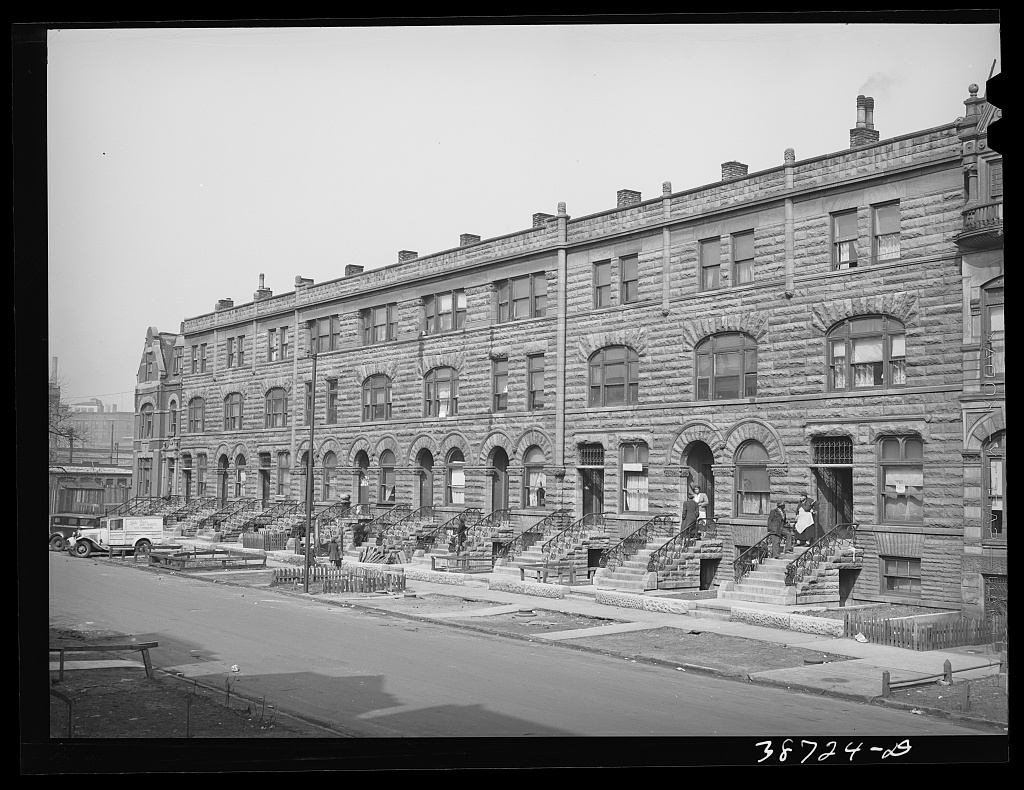
What was happening?
The New Deal created the Home Owners' Loan Corporation (1933) and the Federal Housing Administration (1934), which transformed American homeownership through long-term, low-down-payment mortgages.
What happened?
HOLC drew color-coded maps of 239 cities. Neighborhoods with Black residents were often graded D and outlined in red. The FHA's underwriting manual recommended racially restrictive covenants and discouraged lending in "inharmonious" racial areas.
Why?
Federal appraisal standards treated Black residents as a risk to property values.
How did Black people respond?
Black residents organized, sued (Shelley v. Kraemer, 1948, made covenants unenforceable), built Black-owned lenders, and pushed for the Fair Housing Act of 1968.
What changed?
Discrimination in housing was banned in 1968, a week after Martin Luther King Jr. was assassinated. The Community Reinvestment Act followed in 1977.
What happened next?
Discrimination continued through steering, appraisal bias and predatory lending, including subprime loans before the 2008 crash.
How could this still matter today?
Research finds neighborhoods graded D in the 1930s still had lower homeownership and home values decades later.
Evidence & sources
Evidence rating: What the ratings mean
- Map · 1935–1940Mapping Inequality: Redlining in New Deal America · University of Richmond Digital Scholarship Lab
All HOLC maps and area descriptions, digitized.Nelson, Winling et al., Mapping Inequality. - Federal manual · 1938FHA Underwriting Manual · Federal Housing Administration
Section on neighborhood stability and restrictive covenants.FHA, Underwriting Manual (1938), §937. - Scholarship · 2021"The Effects of the 1930s HOLC Redlining Maps" · Aaronson, Hartley & Mazumder
American Economic Journal: Economic Policy.AEJ: Economic Policy 13(4): 355–392 (2021).
Related stories
- 1944The GI BillSame war. Different benefits.
- 1950s–1960sBlack BottomA neighborhood disappeared.
- 1910–1970The Great MigrationSix million people moved.
Cite this page
APAThe Black American Story. (2026). Redlining. https://www.theblackamericanstory.com/stories/redlining/MLA
"Redlining." The Black American Story, 2026, https://www.theblackamericanstory.com/stories/redlining/. Accessed [date].
Chicago"Redlining." The Black American Story. 2026. https://www.theblackamericanstory.com/stories/redlining/.