Tuskegee
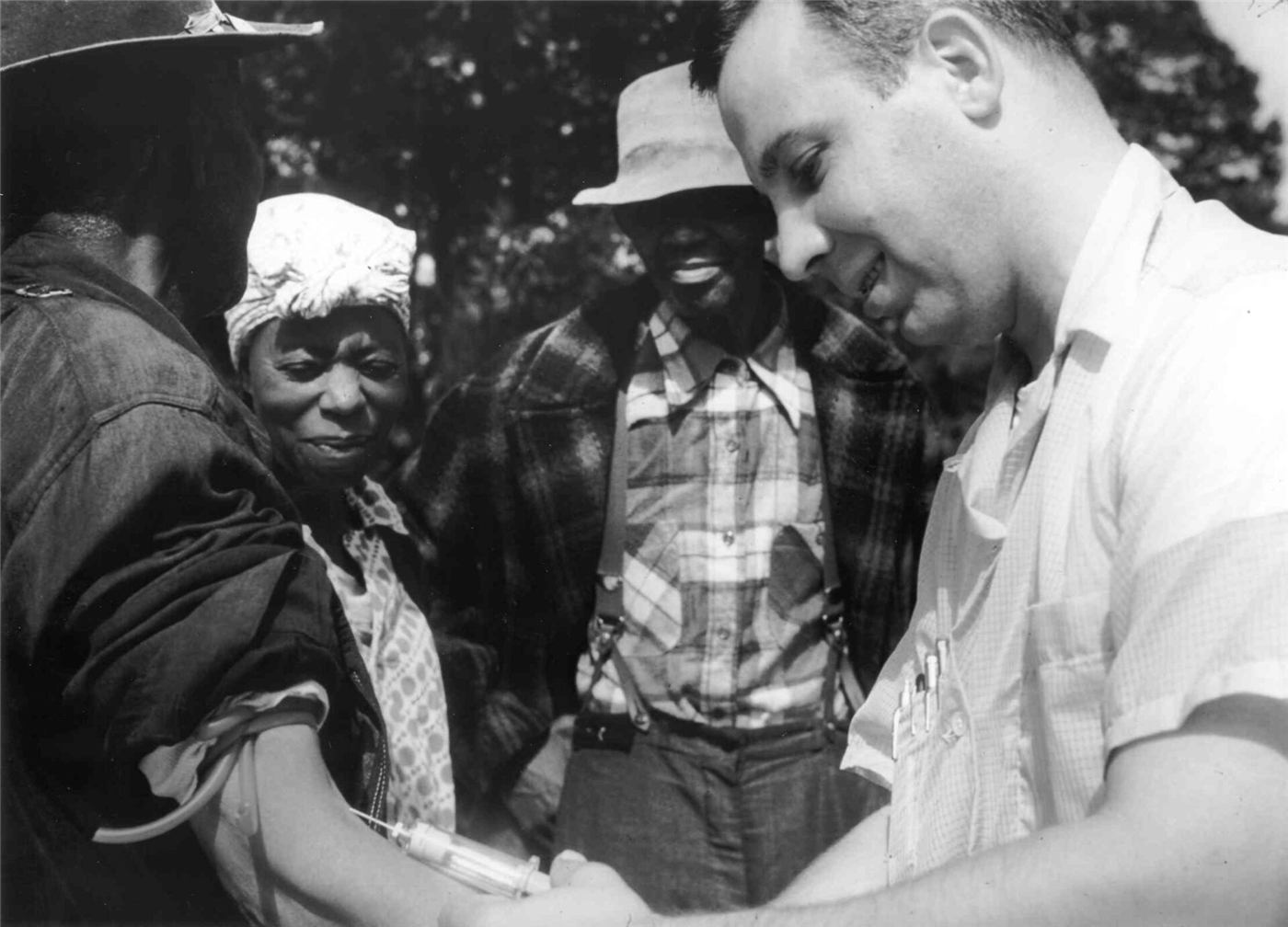
For forty years, the U.S. Public Health Service watched hundreds of Black men go untreated for syphilis.
What was happening?
Macon County was poor and rural. The Public Health Service presented the study as free health care.
What happened?
Researchers enrolled about 600 Black men, roughly 400 with syphilis. They were told they were being treated for "bad blood." Even after penicillin became the standard cure in the late 1940s, treatment was withheld.
Why?
Researchers wanted to observe the disease's natural course to death.
How did Black people respond?
Whistleblower Peter Buxtun pushed for years; AP reporter Jean Heller broke the story in July 1972. Attorney Fred Gray sued on behalf of the men.
What changed?
The study ended in 1972. A 1974 settlement paid about $10 million. The National Research Act (1974) created modern rules for informed consent.
What happened next?
President Clinton formally apologized in 1997.
How could this still matter today?
Economists have found that the 1972 disclosure was followed by lower trust and use of medical care among Black men. Note: the men were not deliberately infected; treatment was withheld.
Evidence & sources
Evidence rating: What the ratings mean
- Government record · The U.S. Public Health Service Untreated Syphilis Study at Tuskegee · Centers for Disease Control and Prevention
Official timeline.CDC. - Scholarship · 2018"Tuskegee and the Health of Black Men" · Marcella Alsan & Marianne Wanamaker
Quarterly Journal of Economics 133(1).QJE 133(1): 407–455 (2018).
Related stories
- 1951Henrietta LacksHer cells changed medicine.
- 1929–1974Coerced SterilizationThe "Mississippi appendectomy."
Cite this page
APAThe Black American Story. (2026). Tuskegee. https://www.theblackamericanstory.com/stories/tuskegee/MLA
"Tuskegee." The Black American Story, 2026, https://www.theblackamericanstory.com/stories/tuskegee/. Accessed [date].
Chicago"Tuskegee." The Black American Story. 2026. https://www.theblackamericanstory.com/stories/tuskegee/.