Memphis, 1866
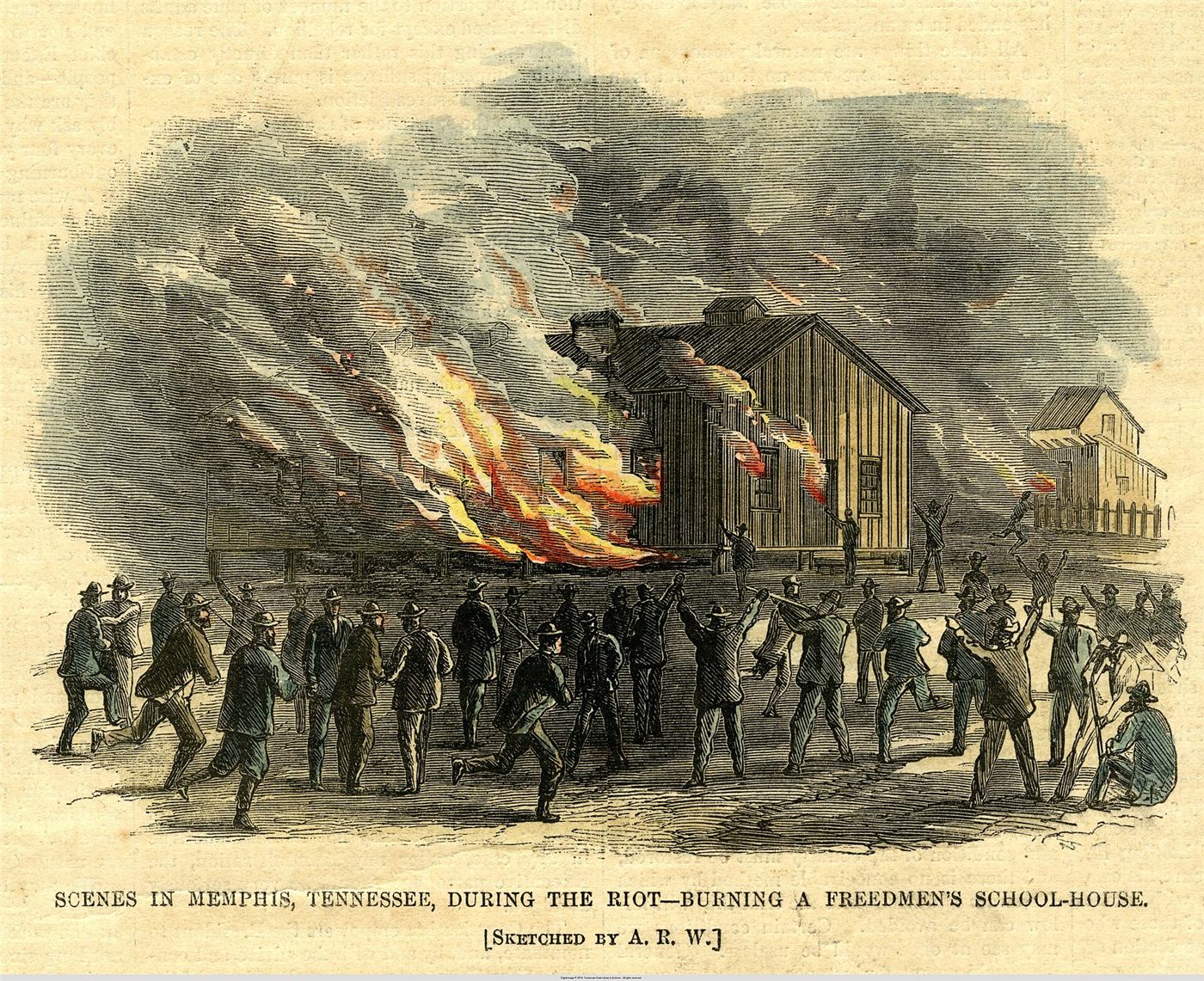
Over three days, white mobs including police killed 46 Black people and burned homes, churches and schools.
What was happening?
Memphis had a growing free Black community and a garrison of Black Union soldiers about to be mustered out.
What happened?
After a confrontation between police and discharged Black soldiers, white mobs, led in part by police, attacked Black neighborhoods. A congressional committee documented 46 Black people killed, many rapes, and the burning of 91 homes, 4 churches and 12 schools.
Why?
Resentment of Black soldiers, competition for work, and hostility to Black freedom.
How did Black people respond?
Survivors testified before Congress in detail, giving the nation one of the most complete records of the violence.
What changed?
The testimony helped turn Northern opinion toward Radical Reconstruction and the 14th Amendment.
What happened next?
Two months later came a similar massacre in New Orleans.
How could this still matter today?
The congressional report is a model of how testimony becomes evidence.
Evidence & sources
Evidence rating: What the ratings mean
- Congressional report · 1866Memphis Riots and Massacres · U.S. House, 39th Congress
House Report No. 101, with survivor testimony.H.R. Rep. No. 39-101 (1866).
Related stories
- July 30, 1866New Orleans, 1866They marched for the vote.
- 1865–1877ReconstructionBlack political power didn't begin in the 1960s.
- April 13, 1873Colfax, 1873The killing was bad. The court ruling made it worse.
Cite this page
APAThe Black American Story. (2026). Memphis, 1866. https://www.theblackamericanstory.com/stories/memphis-1866/MLA
"Memphis, 1866." The Black American Story, 2026, https://www.theblackamericanstory.com/stories/memphis-1866/. Accessed [date].
Chicago"Memphis, 1866." The Black American Story. 2026. https://www.theblackamericanstory.com/stories/memphis-1866/.