Colfax, 1873
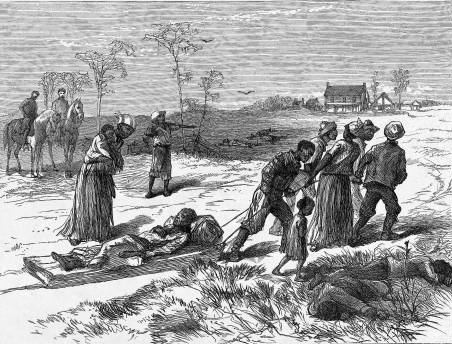
White paramilitaries killed dozens of Black men defending a courthouse, many after they had surrendered.
What was happening?
After a disputed 1872 election, Black Republicans and freedmen held the Grant Parish courthouse to protect Republican officials.
What happened?
On Easter Sunday, an armed white force attacked. Estimates of Black people killed range from about 60 to 150, many killed after surrender.
Why?
To seize local power from Black voters and Republicans.
How did Black people respond?
Federal prosecutors charged attackers under the Enforcement Acts.
What changed?
In United States v. Cruikshank (1876), the Supreme Court ruled that federal civil rights protections applied to state actions, not private individuals. Convictions were overturned.
What happened next?
The ruling left Black Southerners largely unprotected from paramilitary violence for decades.
How could this still matter today?
Cruikshank shaped how far the federal government could go in protecting civil rights until the 1960s.
Evidence & sources
Evidence rating: What the ratings mean
- Court case · 1876United States v. Cruikshank, 92 U.S. 542 · U.S. Supreme Court
Overturned convictions from the massacre.United States v. Cruikshank, 92 U.S. 542 (1876).
Related stories
- July 30, 1866New Orleans, 1866They marched for the vote.
- 1865–1877ReconstructionBlack political power didn't begin in the 1960s.
- Nov 10, 1898Wilmington, 1898An elected government was overthrown.
Cite this page
APAThe Black American Story. (2026). Colfax, 1873. https://www.theblackamericanstory.com/stories/colfax/MLA
"Colfax, 1873." The Black American Story, 2026, https://www.theblackamericanstory.com/stories/colfax/. Accessed [date].
Chicago"Colfax, 1873." The Black American Story. 2026. https://www.theblackamericanstory.com/stories/colfax/.