Freedom Rides
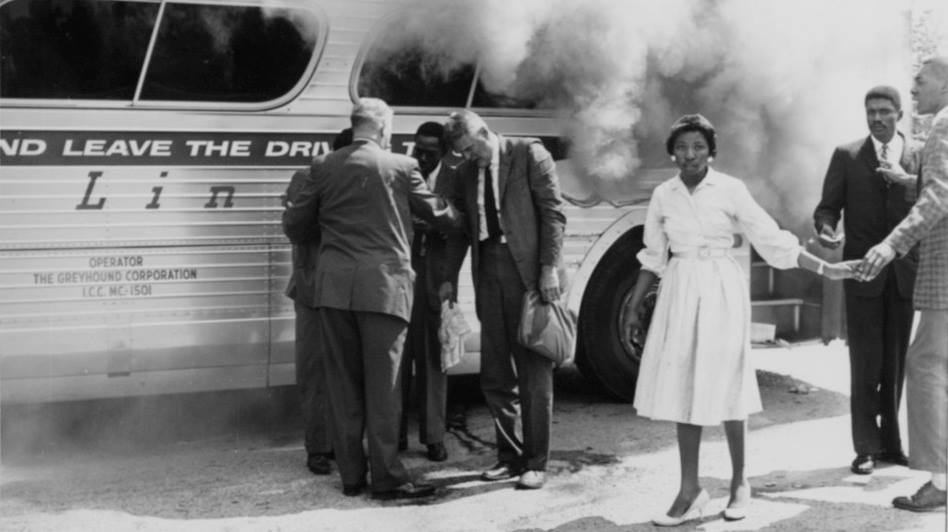
Interracial riders tested a Supreme Court ruling on interstate buses. One bus was firebombed.
What was happening?
The Supreme Court had ruled segregated bus terminals for interstate travel illegal (Boynton v. Virginia, 1960). The South ignored it.
What happened?
CORE organized riders to travel from Washington into the Deep South. Outside Anniston, Alabama, a mob firebombed a bus on May 14. Riders were beaten in Birmingham.
Why?
To force the federal government to enforce its own law.
How did Black people respond?
Diane Nash and Nashville students insisted the rides continue. More than 400 riders followed; hundreds were jailed at Mississippi's Parchman prison.
What changed?
The Interstate Commerce Commission banned segregation in interstate travel facilities, effective November 1, 1961.
What happened next?
The rides trained a generation of organizers.
How could this still matter today?
Direct action can force government to enforce rights it has already recognized on paper.
Evidence & sources
Evidence rating: What the ratings mean
- Court case · 1960Boynton v. Virginia, 364 U.S. 454 · U.S. Supreme Court
The ruling the riders tested.Boynton v. Virginia, 364 U.S. 454 (1960).
Related stories
- Feb 1, 1960Greensboro Sit-insFour freshmen sat down.
- April–May 1963Birmingham, 1963The children marched.
- Summer 1964Freedom SummerThree organizers vanished.
Cite this page
APAThe Black American Story. (2026). Freedom Rides. https://www.theblackamericanstory.com/stories/freedom-rides/MLA
"Freedom Rides." The Black American Story, 2026, https://www.theblackamericanstory.com/stories/freedom-rides/. Accessed [date].
Chicago"Freedom Rides." The Black American Story. 2026. https://www.theblackamericanstory.com/stories/freedom-rides/.