The Black Codes
Months after slavery ended, Southern states made it a crime for Black people to be without a labor contract.
What was happening?
Southern legislatures, controlled by former Confederates in 1865, wanted to restore control over Black labor.
What happened?
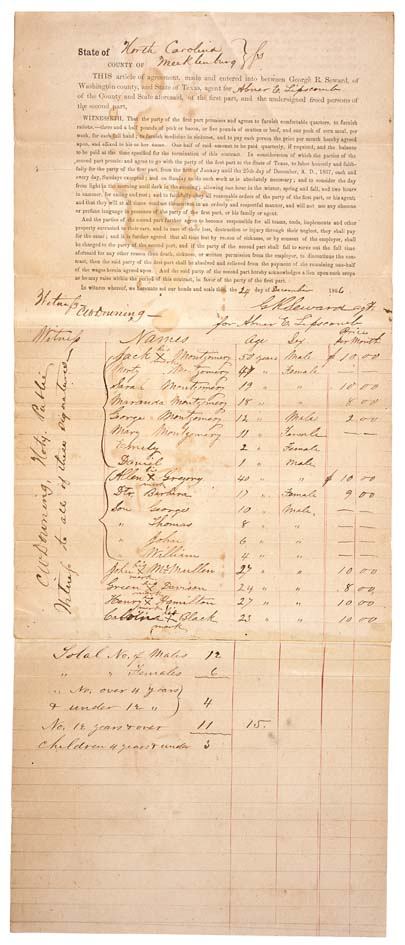
Mississippi and South Carolina passed the first Black Codes in late 1865. They required annual labor contracts, punished "vagrancy," restricted land ownership and gun ownership, and let courts hire out people who could not pay fines.
Why?
To force freedpeople back to plantation labor on terms set by former enslavers.
How did Black people respond?
Freedpeople testified to Congress, organized conventions, and appealed to the Freedmen's Bureau. Northern outrage helped pass the Civil Rights Act of 1866.
What changed?
Congress responded with the Civil Rights Act of 1866, the 14th Amendment, and military Reconstruction.
What happened next?
After Reconstruction, similar laws came back in new forms: vagrancy, loitering, and "pig laws" that fed convict leasing.
How could this still matter today?
Historians trace a long line from vagrancy laws to the over-policing of minor offenses.
Evidence & sources
Evidence rating: What the ratings mean
- Law · November 1865Mississippi Vagrant Law · Mississippi Legislature
One of the first Black Codes.Laws of the State of Mississippi, 1865, pp. 90–93.
Related stories
- 186513th AmendmentRead the exception.
- 1868–1928Convict LeasingArrested. Convicted. Sold to a mine.
- 1865–1877ReconstructionBlack political power didn't begin in the 1960s.
Cite this page
APAThe Black American Story. (2026). The Black Codes. https://www.theblackamericanstory.com/stories/black-codes/MLA
"The Black Codes." The Black American Story, 2026, https://www.theblackamericanstory.com/stories/black-codes/. Accessed [date].
Chicago"The Black Codes." The Black American Story. 2026. https://www.theblackamericanstory.com/stories/black-codes/.